Cornhole is the ultimate equalizer in the world of lawn games. It brings people together at tailgates, backyard barbecues, and family reunions because almost anyone can pick up a bag and play. The beauty of the sport lies in its simplicity, but that does not mean it lacks depth or challenge. For players who navigate the game with the use of only one hand, whether due to a permanent physical difference, a temporary injury, or simply because they are balancing a beverage at a social gathering, the game requires a unique set of adjustments. We believe that everyone deserves the chance to experience the thrill of sinking a perfect airmail shot. Playing one-handed is entirely possible, and with the right technique, you can be just as competitive as anyone else on the court.
Mastering one-handed cornhole is about understanding mechanics, balance, and the importance of high-quality equipment. At Skip’s Garage, we have seen players of all abilities dominate the boards because they focus on consistency and precision. We are committed to helping you refine your game, regardless of your playing style. This guide will walk you through the necessary adjustments to stance, grip, and delivery so you can step up to the line with absolute confidence.
Understanding the Fundamentals of the Game
Before diving into specific one-handed techniques, it is essential to grasp the core mechanics that govern a standard game of cornhole. The regulation court consists of two boards placed twenty-seven feet apart from front edge to front edge. Each player throws four bags per inning, aiming to land them on the board for one point or in the hole for three points. The first team or player to reach or exceed twenty-one points at the conclusion of an inning wins the match. These rules remain constant regardless of how you deliver the bag.
The primary challenge for a one-handed player involves balance and counterbalance. In a standard two-handed throw, the non-throwing arm often acts as a stabilizer or a guide to ensure the body remains aligned with the target. When you remove that guide arm from the equation, your center of gravity shifts. This can affect the trajectory of the bag and the consistency of your release point. Understanding this physical reality is the first step toward correcting it. You must rely more heavily on your core strength, your stance, and the pendulum motion of your throwing arm to generate the necessary power and accuracy.
Adjusting Your Stance and Delivery
The foundation of a great one-handed throw starts with your feet. Many conventional players use a step-and-throw method to generate momentum. However, for one-handed play, a stationary stance often yields better results because it minimizes excessive body movement that can throw off your balance. We recommend standing with your feet shoulder-width apart to create a solid base. If you are throwing with your right hand, place your left foot slightly forward, or keep your feet parallel if that feels more stable. The goal is to minimize lateral sway during your swing.
Your grip on the bag is the next critical element. Without a second hand to help adjust the bean bag before the throw, you need to get comfortable manipulating the bag with your fingers alone. We suggest the butterfly grip or a flat pancake grip, which distributes the resin pellets evenly inside the bag. This ensures the bag flies flat and lands with a satisfying slap on the board. A tumbling bag is harder to control, so focus on keeping your wrist firm and releasing the bag flat off your fingertips.
The throwing motion itself should be a smooth, rhythmic pendulum. Start with the bag down by your hip, bring it back in a straight line, and swing it forward toward the target. Since you do not have an off-hand to point at the target for aim, you must visualize the line from your shoulder to the hole. Follow through is paramount here. Your hand should finish high, pointing directly at the hole. If you cut your follow-through short, the bag will likely fall short. If you swing across your body, the bag will drift off the side of the board. Consistency in this arm slot is what separates casual throwers from competitive players.
The Role of Quality Equipment
Your equipment plays a massive role in your success, perhaps even more so when playing with a modified style. When you are working hard to perfect a one-handed technique, you need to know that your gear will perform consistently every single time. We personally guarantee that using a premium, regulation board will improve your game. Cheap, flimsy boards bounce when the bag hits them, killing your momentum and ruining a perfect slide. You need a board with a solid top and a sturdy frame that absorbs the impact and allows the bag to travel true.
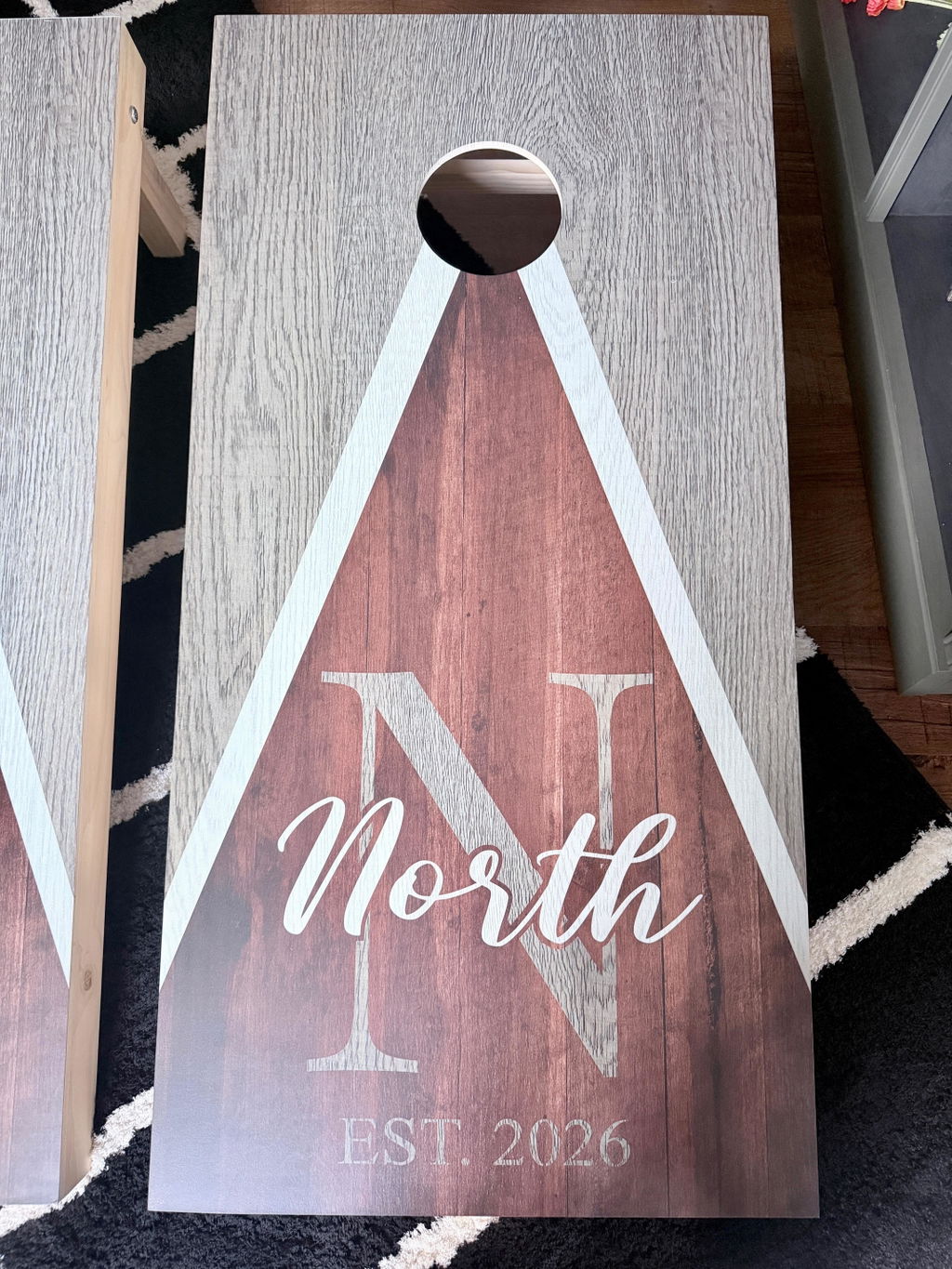
This consistency is vital in various settings. Imagine you are at a reception playing on custom wedding cornhole boards. You might be holding a drink in one hand and throwing with the other. If those boards are slick and professional-grade, your one-handed toss has a much higher chance of sliding into the hole. If the boards are rough or warped, your bag will veer off course regardless of your skill level.
Furthermore, the bags themselves must be up to par. We only work with manufacturers who use quality duck cloth and consistent resin fills. A bag that is too loose or too tight will react unpredictably. For a one-handed player, a "sticky" side and a "slick" side on the bag are incredibly useful tools. You can use the slick side to push other bags into the hole or the sticky side to place a precise blocker. Having confidence in your gear allows you to focus entirely on your mechanics.

Drills to Sharpen Your Accuracy
Practice is the only way to build muscle memory, and specific drills can help you overcome the lack of a counterbalance. We recommend starting with the Line Drill. Stand directly in front of the board at a shorter distance, perhaps fifteen feet. Focus entirely on keeping your arm swing perfectly straight. Do not worry about distance yet; just ensure the bag lands in line with the hole. Once you can throw ten bags in a row without deviating left or right, move back a few feet and repeat the process until you are at the full twenty-seven feet.
Another effective exercise is the Arc Drill. This focuses on the height of your throw. A flat throw has a higher margin for error, often sliding off the back. A throw with a healthy arc will land softly and stay on the board. Set up an obstacle, such as a folding chair or a string, about halfway between you and the board. Practice throwing over the obstacle to force yourself to release the bag at a higher point. This helps ingrain that crucial follow-through motion we discussed earlier.
Finally, work on the Stationary Drill. Eliminate all leg movement and throw entirely from your upper body and core. This strengthens the specific muscles used in a one-handed delivery and teaches you to rely on technique rather than momentum. Once you master the stationary throw, adding a small step back in will make your toss feel effortless and powerful.
Community and Adaptive Resources
You are not alone in adapting the game to your needs. The cornhole community is one of the most welcoming groups in sports. Organizations like the American Cornhole Organization (ACO) and various local leagues are increasingly recognizing adaptive players. There are thriving communities online where players share tips on how they navigate physical limitations to compete at high levels.
We encourage you to seek out local clubs or online forums dedicated to adaptive sports. Seeing how others adjust their wheelchairs, stances, or delivery styles can provide lightbulb moments for your own game. The camaraderie found in these groups reinforces the idea that cornhole is truly a game for everyone. Whether you are playing in a backyard or a tournament, the passion for the game is the common thread that binds us all.
Taking Your Shot
Playing cornhole with one hand is not just about making do; it is about mastering a specific skill set that can be just as effective as the traditional style. By adjusting your stance to create a stable base, focusing on a smooth pendulum swing, and utilizing high-quality equipment that rewards precision, you can compete with the best of them. At Skip’s Garage, we believe that the key to any successful player is dedication and the right tools.
We take pride in providing the craftsmanship that supports your journey. From the sturdy construction of our boards to the durability of our bags, we ensure that you are getting the absolute best product to support your game. Do not let anything hold you back from stepping up to the line. Grab your bags, focus on your target, and let them fly. We guarantee that with practice and the right mindset, you will be sinking shots and taking names in no time.